
Jan, you are stepping down as Chair. What made this the right moment for a change in leadership?
De Blauwe: “It’s certainly not because I ran out of ideas! For me, it’s a matter of good governance. Organisations benefit from fresh perspectives that allow a renewed course to be set. To ensure continuity, we prepared the transition very carefully. Over the past year, Karine has been taking on a sort of dual role alongside me, giving her the opportunity to grow into the position.”
Does the organisation you leave behind resemble what you originally had in mind?
De Blauwe: “First and foremost, we are a membership organisation, so success is reflected in our numbers. We’ve grown from around 50 members to 200. But our role has evolved as well. Initially, we were mainly a meeting place for practitioners. We deliberately broadened that scope to include vendors within our membership. However, we do so in moderation, as the Coalition should never turn into a marketplace. Vendors are here as carriers of knowledge, not as salespeople. Equally important is the team behind the organisation. Recruiting the right profiles has been a crucial part of our success.”
What will be the focus in this new era?
Goris: “Today, we still see too many organisations, large and small, grappling with the same challenges in isolation. There is clear potential to collaborate more intensively. And that’s essential, because cyber threats are no longer hypothetical, and they pose a real risk to our economy and society. The Coalition can act as a catalyst here, facilitating the sharing of knowledge, threat intelligence and best practices. We must also ensure that solutions can be applied across sectors, and we need to develop more practical tools and frameworks, particularly for SMEs, many of whom are newer to these challenges. Finally, we must continue to enhance alignment and cooperation between government, academia and the private sector. In short, we must continue to operationalise collaboration and move towards a model of mutualisation.”
De Blauwe: “The strongest membership growth has been among SMEs, which is encouraging, but we still see a lot of untapped potential in this segment. Meanwhile, there are also several sectors, from logistics to pharma, where we remain underrepresented. It’s my conviction that for an organisation that aims to be a network, more is better.”
What will determine the success of this next phase?
Goris: “It ultimately comes down to building a culture of trust. The cyber domain has become so vast that no one can be a specialist in everything. That means information and insights must be shared. Only then can we bring together different areas of expertise and reduce fragmentation within this domain.”
In recent weeks, we saw a phishing surge in Belgium, alongside calls from the federal government for the banking sector to take stronger action. What does this say about the current momentum in cybersecurity?
Goris: “Let us be honest: phishing is no longer an isolated incident — it has become a structural societal problem. The figures and awareness campaigns have been telling us this story for years: millions of suspicious messages every year, coupled with an increasingly professional approach by criminal networks. Banks already have strong fraud detection systems and organisational structures in place, often operating 24/7, to monitor and block suspicious activity. What we are seeing now, with the federal government explicitly calling on the banking sector to step up, essentially confirms one thing: this is not a sectoral problem, it is an ecosystem problem. And that is precisely where the Coalition has a role to play. We operate at the crossroads of the banking sector, government and other industries. The Coalition therefore acts as a facilitator: sharing knowledge, accelerating the dissemination of threat intelligence, and — crucially — ensuring that initiatives are aligned rather than developed in isolation. Joint awareness campaigns with the Centre for Cybersecurity Belgium and the sector, for example, are a clear illustration of mutualisation in action. Is there momentum? Absolutely. Government pressure, the visibility of the issue and the maturity of the sector are now converging. But momentum alone is not enough. The real opportunity lies in using this moment to build structural cooperation: shared detection capabilities, coordinated communication towards citizens, and — where possible — joint defensive mechanisms.”
The geopolitical context has also made cyber threats more tangible and politically charged than ever. Does this change the Coalition’s role?
De Blauwe: “The need for speed in such a complex domain has only increased, but the Coalition is just one part of the answer. It’s important to stress that Coalition membership is voluntary. People choose to be part of it and that’s exactly its strength — one that is often envied abroad. In this context, membership fees can be seen as symbolic; the real value that we expect from our members is active participation.”
Goris: “Geopolitical realities have fundamentally changed cyber defence. It’s no longer just about crime, but also state-sponsored threats and hybrid conflicts. For the Coalition and its members, it is clear that the bar has been raised significantly. Organisations must not only withstand attacks, but also more advanced, targeted threats. That level of maturity requires a different kind of collaboration. This is where the opportunity for deeper mutualisation and stronger cross-sector connections lies.”
At the same time, the focus today seems to be firmly on competitiveness and AI-driven innovation. What does that mean for cybersecurity?
Goris: “I understand that this trend is dominant, but it is a misconception to separate cyber from it. Deploying AI rapidly without security by design creates a larger attack surface. Without cyber resilience, there is no sustainable innovation. However, I believe that the Belgian business community has become more aware that cybersecurity does not hinder innovation. Rather, it enables competitiveness.”
De Blauwe: “I hope that the idea that cybersecurity comes at the expense of innovation is behind us. In reality, it’s the opposite. We simply have to move along the speed of the AI revolution, so the real question is how to integrate cybersecurity considerations.”
Goris: “AI and post-quantum technologies are receiving a great deal of attention, but ultimately everything revolves around interconnectivity and the broader digitalisation of life. Within this interconnected world, the system as a whole must remain secure. You cannot approach these challenges in isolation or you will inevitably fall behind reality. The approach has to be collective. It’s a complex but compelling challenge, and this is precisely where the Coalition can make a difference.”
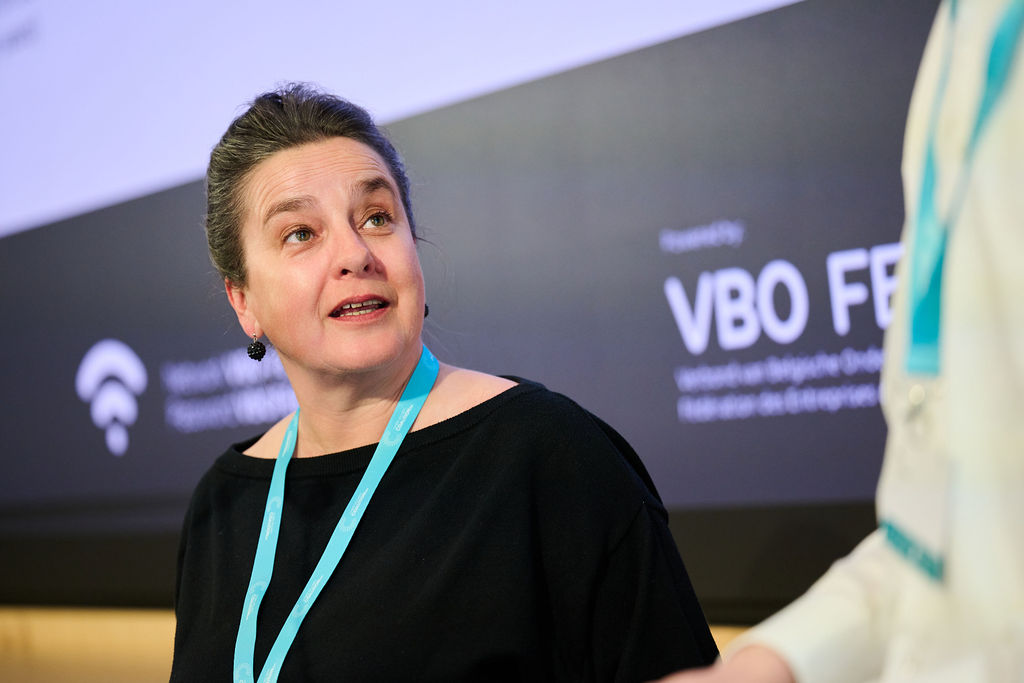
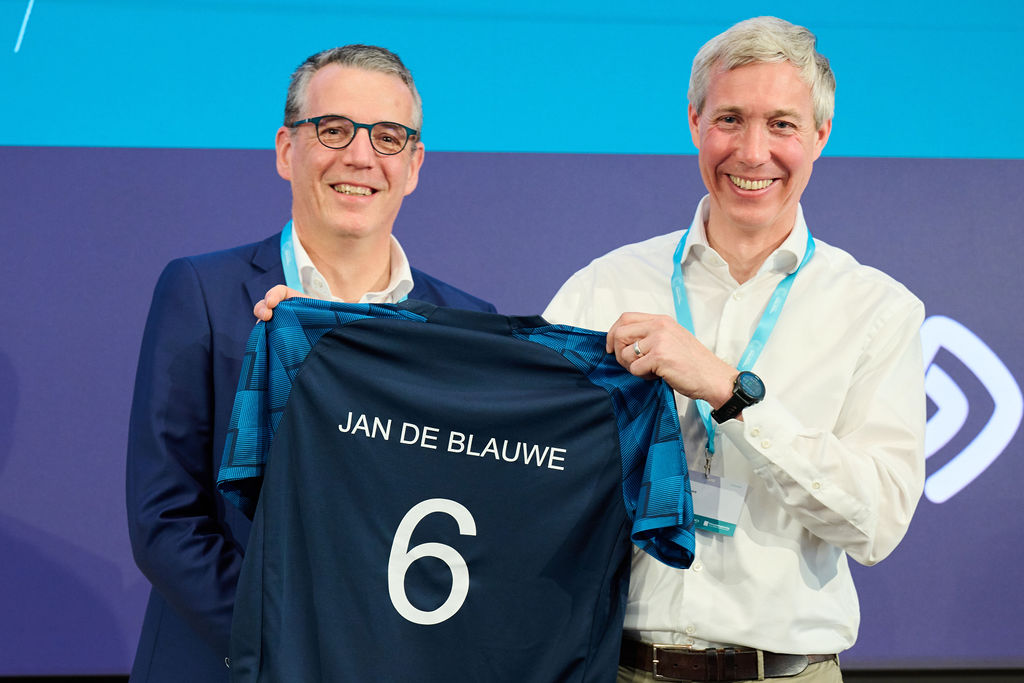
Picture 1: Karine Goris; Picture 2: Henk Dujardin, paying a warm tribute to Jan De Blauwe during the General Assembly of 2 April 2026 where he announced the handover of the Chair to Karine Goris