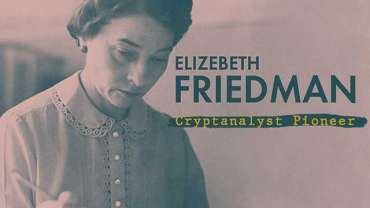

Elizebeth Smith Friedman gave the draft of her unfinished memoir the title Footnote to History. The title may reflect her personal modesty, but it also seems an apt reflection of the lack of recognition her work received during her lifetime, much of it remaining hidden from public view because of its top-secret classification.
Elizebeth’s memoir is held at the George C. Marshall Foundation, where it has been preserved since her death. It can be consulted via the following link.
You can hardly get closer to this extraordinary woman: a Shakespeare enthusiast, cryptanalyst and pioneer of American cryptology. Elizebeth died on 31 October 1980 in Plainfield, New Jersey, at the age of 88.
Although she is often introduced as the wife of William Friedman, she achieved considerable success in cryptology in her own right and has been described as “America’s first female cryptanalyst”. Indeed, while her husband is credited with numerous contributions to the field, it was Elizebeth who first introduced him to cryptology.
From Shakespeare to secret codes
Elizebeth Smith was born on 26 August 1892 in Huntington, Indiana, the youngest surviving child in a large Quaker family. Her mother gave her the unusual spelling Elizebeth, determined that her daughter should never be called Eliza.
She studied English literature at Hillsdale College in Michigan, graduating in 1915. Her original ambition was to become a teacher and pursue a literary career. Cryptography, as far as we know, was not part of her career plans.
Fate, however, had other ideas.
In 1916, Elizebeth was recruited by the eccentric American businessman and philanthropist George Fabyan to work at his private research institution, Riverbank Laboratories, near Chicago. Fabyan was fascinated by the theory that Francis Bacon had secretly written Shakespeare’s plays. He employed researchers to investigate the alleged hidden messages in Shakespeare’s works.
The Shakespeare–Bacon hypothesis would eventually prove to be a scholarly dead end, but the experience introduced Elizebeth to the study of codes, patterns and concealed information.
It was at Riverbank that she met William Friedman, another researcher working on the Baconian theory. They married in 1917. William would go on to become one of America’s most influential cryptologists, but Elizebeth was very much a cryptanalyst in her own right. Their marriage was, among other things, an unusually successful partnership in the business of making secrets less secret.
During the First World War, Riverbank became an important centre for American codebreaking. Elizebeth and William helped train government personnel and contributed to the development of American cryptanalytic methods. Elizebeth proved particularly gifted at recognising patterns in encrypted communications. Far from being an obstacle, her literary education gave her a sophisticated understanding of language, structure and context.
From smuggler to spies
After the First World War, Elizebeth’s career took a rather unexpected turn: she became one of the American government’s most effective weapons against organised smuggling.
During Prohibition (1920–1933), the illegal alcohol trade generated an enormous amount of business. Criminal organisations used coded messages to coordinate shipments, evade law enforcement and communicate across borders.
Elizebeth also played an important role in cases involving international drug trafficking and the use of coded radio communications by criminal organisations.
Her expertise was so highly regarded that she became a key figure in American efforts to combat organised crime, at a time when the criminals’ technology was often considerably less sophisticated than their ambitions.
During the Second World War, Elizebeth’s expertise acquired even greater strategic importance.
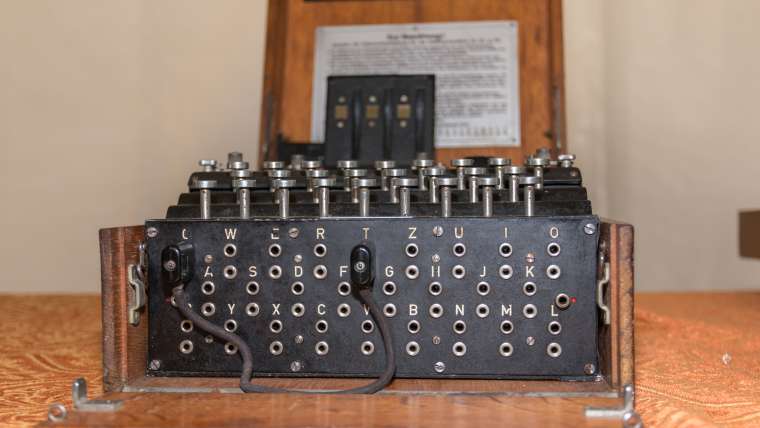
She worked for the US Navy, analysing encrypted communications between German intelligence networks and their agents in South America. These networks were transmitting information about Allied shipping and military activities.
Her work included deciphering sophisticated communications associated with German espionage operations. One particularly important achievement concerned messages relating to the Queen Mary, the enormous ocean liner being used as a troopship.
In 1942, intelligence derived from her team’s work helped protect the ship and the approximately 8,000 troops aboard it.
She also contributed to exposing German spy networks in South America and helped uncover the activities of Japanese spy Velvalee Dickinson, who used coded communications to transmit information to Japan.
The woman behind the secrets
There is an important gender dimension to this history.
Much of this work was conducted in secrecy. Elizebeth and her colleagues were required to maintain strict confidentiality about their wartime achievements. The public could not know what they had accomplished, and they were unable to correct the historical record when others received recognition.
FBI Director J. Edgar Hoover was able to claim considerable public credit for the dismantling of German espionage networks, while much of the cryptanalytic work that helped make these operations possible remained largely invisible.
For Elizebeth, this meant that professional recognition was not simply delayed; it was effectively obstructed by the very secrecy that made her work so valuable.
Her story raises an uncomfortable question:
How many women have disappeared from the history of intelligence, not because their contributions were insignificant, but because the institutions they served were unwilling or unable to acknowledge them?
When her wartime cryptanalytic unit was disbanded in 1945, Elizebeth’s government career entered a new phase.
She later worked as a consultant to the International Monetary Fund, helping to develop secure communications systems.
Her interest in Shakespeare also remained with her. Together with William, she published The Shakespearean Ciphers Examined in 1957, a scholarly examination of the claims surrounding the supposed hidden authorship of Shakespeare’s works.
No longer a footnote
Elizebeth died on 31 October 1980, aged 88, leaving behind a remarkable body of work and an important legacy in the history of intelligence and cryptography.
It was not until 2008, when significant wartime records were declassified, that the full extent of her contribution to American intelligence began to receive wider recognition.
Perhaps the title of her unfinished memoir, Footnote to History, was more prophetic than she could have imagined. She spent her life deciphering other people’s secrets. It took history considerably longer to uncover hers.