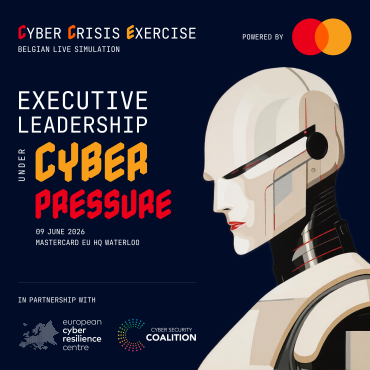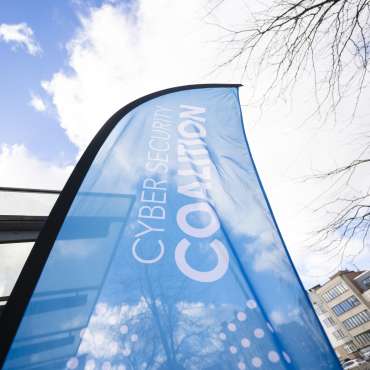

Waterloo, Belgium – 9 June 2026 – Mastercard, in partnership with the Belgian Cyber Security Coalition, is bringing together senior cybersecurity and risk leaders from across Belgium for an exclusive Cyber Crisis Exercise (CCE), aimed at strengthening collective resilience in the face of rapidly evolving cyber threats. The event builds on the long-standing collaboration between Mastercard and the Coalition to foster cross-sector cooperation and strengthen Belgium’s cybersecurity ecosystem.
The initiative comes at a critical time: in Belgium, half of organisations report an increase in cyberattacks, while one in six have already experienced a successful incident. In parallel, the Centre for Cybersecurity Belgium handled 635 incidents in 2025, alongside millions of phishing reports, highlighting the scale and sophistication of today’s threat landscape (cf. Cyber Survey Belgium 2025).
Immersive simulation for executive decision-making
Participants take part in a closed-door, immersive simulation, placing them in the role of an executive team managing a fast-evolving cyber crisis.
Designed using advanced threat intelligence and recent attack patterns affecting Belgian organisations, the simulation challenges leaders to make critical decisions under pressure, with real-time implications across operations, reputation, regulatory exposure and stakeholder communication.
Cross-sector collaboration at the core
The event gathers leaders from financial services, industry, telecom, energy and other critical sectors, fostering peer exchange and collaboration across the ecosystem.
Speakers include:
- Karine Goris, Chief Security Officer, Belfius and Chair of the Cyber Security Coalition
- Karolien Dewit, Cyber Security Manager, Brussels Airport Company
- Marc Vael, Chief Digital Trust Officer, Esko
- Rigo Van den Broek, Global EVP Cybersecurity Solutions, Mastercard
“Cyber threats are increasingly systemic, affecting every sector of our economy. Building resilience requires close public-private collaboration,” said Henk Dujardin, CEO of the Belgian Cyber Security Coalition. “Exercises like this are essential to help leaders anticipate crises, share experience and strengthen collective preparedness—ensuring a holistic response to cyber challenges across all stakeholders.”
Securing the digital ecosystem through technology and collaboration
As a technology company at the heart of the global payment ecosystem, Mastercard combines data, advanced analytics and cybersecurity expertise to help protect transactions and strengthen resilience. Its network processes billions of transactions each year, leveraging AI and real-time intelligence to detect and prevent fraud.
Through its cybersecurity and fraud prevention capabilities, Mastercard has helped prevent more than $77 billion in fraud globally, while continuously monitoring risk signals across its network.
In Belgium and across Europe, the company works closely with financial institutions, businesses and public authorities to strengthen collective resilience and maintain trust in the digital economy.
A European hub for cyber resilience
Participants will also visit Mastercard’s European Cyber Resilience Centre in Waterloo, a state-of-the-art hub supporting cyber defence and collaboration across Europe.
Opened in 2024, the Centre brings together more than 20 specialised teams, including a fusion centre for incident response and a digital forensics lab, working alongside partners from the public and private sectors.
By fostering cooperation with law enforcement, cyber intelligence centres and industry stakeholders, the Centre plays a key role in strengthening Europe’s ability to detect, respond to and prevent cyber threats at scale.
“As cyber threats become more sophisticated, organisations need both advanced technology and real-time intelligence to respond effectively,” said Benjamin Dessy, Country Manager, Mastercard Belgium and Luxembourg. “At Mastercard, we leverage data, AI and global threat insights to help detect risks earlier, protect transactions and support our partners in strengthening their resilience.”